AI at Spine
Building smarter ways to work
A centralized space for department-wise AI solutions, workflow automations, and practical tools built to reduce manual effort and create more time for meaningful work.
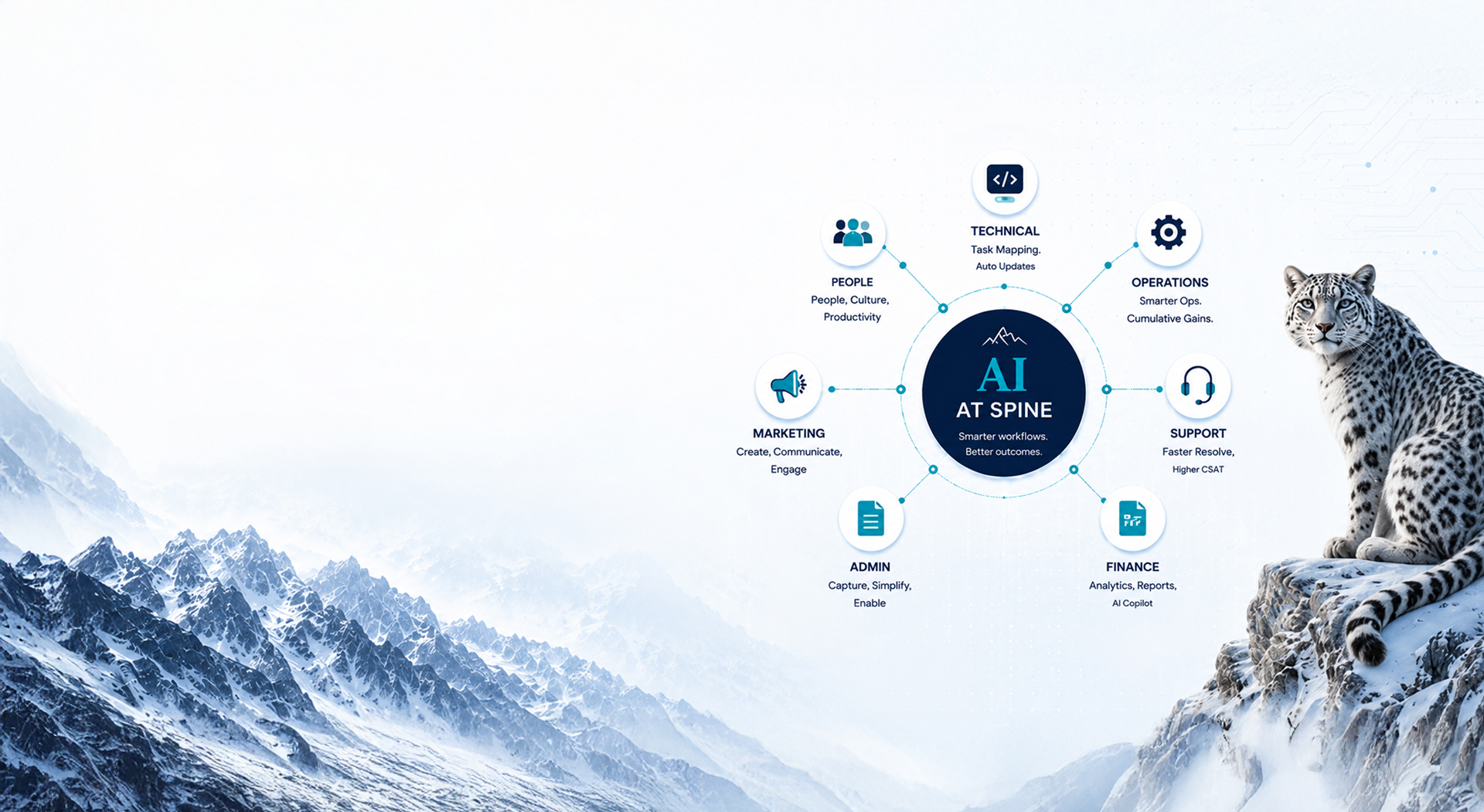

From adoption to action
AI adoption becomes meaningful when it solves real workflow problems. At Spine Software Systems, teams are identifying manual, repetitive tasks and building practical solutions that simplify everyday work.
Idea to workflow
AI experts
Automation
Time saved,
impact made
8+
Departments involved
25+
Workflow ideas identified
10+
Solutions in progress
5+
Reusable tools explored
ChangeHUB
A full-context document layer that feeds structured project knowledge to an AI agent — enabling it to fully understand requirements, architecture, and conventions upfront, so software is built accurately with minimal back-and-forth prompting.
⚠ Why they needed it
"Every development session started with re-explaining the same context. The AI kept making assumptions, missing conventions, and producing code that needed heavy correction — because it was working blind without the full picture."
✓ What changed
"The agent walks in with complete project understanding from day one. Less time spent prompting, less time fixing misaligned output — and the code it produces actually fits the system it's being built for."
SmartGrid QA
Intelligently validates grid-based data structures, detects logic errors, and runs automated quality checks across software builds — keeping development cycles clean and release-ready.
⚠ Why they needed it
"Grid validation was entirely manual. Developers were spending hours cross-checking data layouts, and subtle logic errors were slipping into builds and only surfacing during UAT."
✓ What changed
"Validation that once took half a sprint now happens automatically on every build. Bugs are caught at the source — UAT cycles are shorter and the team ships with a lot more confidence."
SeleniumAPI Test Studio using OpenAPI
An AI-assisted API testing platform that uses OpenAPI specifications to automatically generate, organize, and execute API test cases. It simplifies endpoint validation, improves testing accuracy, and accelerates API quality assurance throughout the development lifecycle.
⚠ Why they needed it
"Creating and maintaining API test cases manually for every endpoint was repetitive and time-consuming. The team needed an automated solution that could generate accurate test scenarios from OpenAPI specifications while reducing testing effort and errors."
✓ What changed
"The platform now generates and executes API test cases directly from OpenAPI definitions, reducing manual work, improving test consistency, accelerating validation, and enabling faster, more reliable software releases."
Database Schema & RLS Anomaly Detector
Compares staging and production database schemas to detect missing or unexpected tables and columns — auto-generating ready-to-use SQL scripts to fix drift. Also validates Row-Level Security policies on qualified tables and sends instant email alerts when RLS anomalies are detected.
⚠ Why they needed it
"Schema differences between staging and production were only discovered during deployments. A missing column or an unenforced RLS policy could silently break data access rules — and by the time anyone noticed, the damage was already done."
✓ What changed
"Environment drift is caught automatically before it becomes a production incident. SQL fix scripts are generated instantly, RLS gaps are flagged via email the moment they appear — and both environments stay consistently in sync."
RLSAutomated Database Migration
An automated migration framework that simplifies schema updates, database replication, and AWS-based production deployments. It minimizes release downtime through scripted execution and reliable environment synchronization.
⚠ Why they needed it
"Database migrations required manual execution, extensive coordination, and prolonged production downtime. The process increased deployment risks and slowed software releases across development and production environments."
✓ What changed
"Automated migration scripts, replication workflows, and AWS integration significantly reduce deployment time and manual effort. The solution enables safer production releases with minimal downtime and greater operational reliability."
Agentic Dev Pipeline
A fully automated software maintenance pipeline that detects critical bugs, writes fixes, validates them in an isolated sandbox, and raises a Draft Pull Request — with a human always holding final approval before anything merges to production.
⚠ Why they needed it
"Critical bugs forced engineers to drop everything. Feature momentum ground to a halt while the team hunted through millions of lines of code manually — with unpredictable resolution timelines and no reliable fix process."
✓ What changed
"The pipeline now handles bug detection, fix generation, testing, and PR creation autonomously. Engineers review a ready-to-merge Draft PR instead of starting from scratch — resolution time dropped dramatically and nothing ships without human sign-off."
Schema CoercionLuna SSO
A centralized Single Sign-On platform that enables users to securely access multiple internal applications using one authentication system. It simplifies identity management while improving security and user experience.
⚠ Why they needed it
"Managing separate usernames and passwords across multiple applications increased security risks, administrative overhead, and user inconvenience. Organizations needed one secure identity platform for all internal systems."
✓ What changed
"Luna SSO provides one-click secure authentication across connected applications with centralized role management. It simplifies user access, improves security, and reduces the complexity of managing multiple credentials."
RBACAI-Powered Schema Anomaly Detection Agent
Automatically monitors database schemas for structural anomalies, unexpected changes, and drift — alerting teams before issues reach production.
⚠ Why they needed it
"Schema changes were happening silently. By the time we caught a column drop or a type mismatch, it had already broken downstream pipelines and taken hours to trace back."
✓ What changed
"Anomalies are flagged the moment they appear. The team now catches schema drift in minutes, not days — and deployments feel a lot less risky."
Database Tuning Intelligence Agent
An AI-assisted MySQL optimization platform that continuously analyzes database health, identifies configuration bottlenecks, and recommends intelligent tuning actions to improve performance, stability, and resource utilization.
⚠ Why they needed it
"The production database suffered from poor configuration, underutilized resources, and slow performance. Manual analysis and tuning required significant DBA effort while increasing the risk of operational issues."
✓ What changed
"The platform automatically assesses database health, recommends optimized configurations, and guides safe implementation through phased tuning. It helps DBAs improve performance, reduce downtime, and achieve a healthier database environment."
AI Database Testing Agent
Automates database testing by validating data integrity, schema consistency, and query outputs — ensuring quality at every stage of the release cycle.
⚠ Why they needed it
"Manual database testing was a bottleneck before every release. Writing test cases took days, edge cases were missed, and bugs were only caught after deployment."
✓ What changed
"Test coverage that used to take 3 days now runs in under an hour. Defects are caught before code ever reaches production — releases are faster and far more confident."
Hive Mind QA
An AI-powered ERP testing platform that automatically analyzes application source code and generates comprehensive software test cases. It improves testing coverage while significantly reducing manual QA effort.
⚠ Why they needed it
"Creating ERP test cases manually required extensive code analysis, business understanding, and documentation, resulting in inconsistent coverage, higher effort, and slower testing cycles."
✓ What changed
"Hive Mind QA automatically generates detailed functional, API, security, database, and compliance test cases within minutes. This improves testing consistency, accelerates QA activities, and prepares the foundation for autonomous testing."
Luna Inkprint
Automates database testing by validating data integrity, schema consisteA rule-based blog publishing agent that automatically visits the website and publishes content with the correct slug, meta title, meta description, interlinking, FAQ schema, and all required SEO elements — zero manual CMS work needed.ncy, and query outputs — ensuring quality at every stage of the release cycle.
⚠ Why they needed it
"Publishing a single blog took 45 minutes of repetitive CMS work — setting slugs, writing meta tags, adding internal links, embedding schema. One missed element meant SEO value was lost before the post even went live."
✓ What changed
"Blogs are now published in under 2 minutes, fully optimised. Slugs, meta tags, FAQ schema, and interlinks are handled automatically — the team just writes, the agent does the rest."
Meta Scan
An AI-powered SEO auditing tool that scans multiple website URLs in a single workflow to analyze meta titles, descriptions, headings, canonical URLs, Open Graph tags, and image alt text. It generates a comprehensive health report based on SEO best practices.
⚠ Why they needed it
"Auditing SEO elements across large websites was manual, repetitive, and time-consuming. Reviewing meta tags, headings, canonical URLs, and image alt text page by page made it difficult to identify issues and maintain SEO quality consistently."
✓ What changed
"Meta Scan now audits multiple URLs automatically, validates SEO elements against best practices, flags issues instantly, and generates a health report with pass, warning, and fail status, significantly reducing manual effort."
DPDP Act 2023 — Compliance Scanner
Automatically scans systems, data flows, and storage practices against the Digital Personal Data Protection Act 2023 — identifying non-compliant elements and flagging risks before they become violations.
⚠ Why they needed it
"DPDP Act compliance was being tracked manually through spreadsheets. With data spread across multiple systems, there was no reliable way to know if we were fully compliant — or where the gaps were."
✓ What changed
"Compliance checks that took weeks of manual auditing now run automatically. Gaps are surfaced instantly, reports are ready on demand, and the team can demonstrate DPDP readiness at any point in time."
ScriptBridge
A self-hosted web UI to manage, execute, and monitor Python scripts on remote servers via SSH — with cron orchestration, role-based access control, and live server monitoring, all from a single interface.
⚠ Why they needed it
"Managing scripts across remote servers meant SSH-ing into machines manually, running commands blind, and hoping nothing broke. There was no visibility, no access control, and no way to know if a scheduled job had actually run."
✓ What changed
"Every script, every server, every cron job is now visible and controllable from one place. The right people have the right access — and the team gets real-time feedback instead of finding out something failed hours later."
Vision Forge AI
A self-hosted AI image generation platform that transforms images into multiple artistic styles using Stable Diffusion. It enables secure, private, and brand-focused creative asset generation while keeping all data within the organization's infrastructure.
⚠ Why they needed it
"Marketing teams spent significant time creating visuals and depended on third-party AI tools that introduced privacy concerns, subscription costs, and inconsistent brand outputs. An internal solution was needed for secure creative production."
✓ What changed
"Vision Forge AI enables teams to generate high-quality branded artwork within a secure environment. The platform reduces creative turnaround time, supports multiple visual styles, and allows faster production of marketing assets without external dependencies."
Spine Elevator
A centralized employee management platform that organizes reporting hierarchies, employee records, project assignments, and collaboration. It provides administrators with a unified view of workforce information and organizational structure.
⚠ Why they needed it
"Employee records, reporting relationships, project ownership, and communication were maintained across multiple systems, increasing administrative effort and limiting visibility into organizational operations."
✓ What changed
"The platform centralizes workforce information, reporting structures, project assignments, and collaboration tools. Automated updates and hierarchy-based access improve administration, communication, and organizational transparency."
Automated Meeting Room Booking Tool
An AI-enabled meeting room booking system that automates room reservations, checks availability in real time, prevents scheduling conflicts, and streamlines meeting management through a centralized and user-friendly booking interface.
⚠ Why they needed it
"Meeting room reservations were managed manually, leading to double bookings, scheduling conflicts, and time-consuming coordination. The team needed a centralized system to simplify room allocation and improve resource utilization."
✓ What changed
"The tool automates meeting room reservations, displays real-time availability, prevents booking conflicts, and simplifies scheduling through a centralized platform, reducing manual coordination and improving operational efficiency."
ChangeHUB
A full-context document layer that feeds structured project knowledge to an AI agent — enabling it to fully understand requirements, architecture, and conventions upfront, so software is built accurately with minimal back-and-forth prompting.
⚠ Why they needed it
"Every development session started with re-explaining the same context. The AI kept making assumptions, missing conventions, and producing code that needed heavy correction — because it was working blind without the full picture."
✓ What changed
"The agent walks in with complete project understanding from day one. Less time spent prompting, less time fixing misaligned output — and the code it produces actually fits the system it's being built for."
SmartGrid QA
Intelligently validates grid-based data structures, detects logic errors, and runs automated quality checks across software builds — keeping development cycles clean and release-ready.
⚠ Why they needed it
"Grid validation was entirely manual. Developers were spending hours cross-checking data layouts, and subtle logic errors were slipping into builds and only surfacing during UAT."
✓ What changed
"Validation that once took half a sprint now happens automatically on every build. Bugs are caught at the source — UAT cycles are shorter and the team ships with a lot more confidence."
SeleniumAPI Test Studio using OpenAPI
An AI-assisted API testing platform that uses OpenAPI specifications to automatically generate, organize, and execute API test cases. It simplifies endpoint validation, improves testing accuracy, and accelerates API quality assurance throughout the development lifecycle.
⚠ Why they needed it
"Creating and maintaining API test cases manually for every endpoint was repetitive and time-consuming. The team needed an automated solution that could generate accurate test scenarios from OpenAPI specifications while reducing testing effort and errors."
✓ What changed
"The platform now generates and executes API test cases directly from OpenAPI definitions, reducing manual work, improving test consistency, accelerating validation, and enabling faster, more reliable software releases."
Database Schema & RLS Anomaly Detector
Compares staging and production database schemas to detect missing or unexpected tables and columns — auto-generating ready-to-use SQL scripts to fix drift. Also validates Row-Level Security policies on qualified tables and sends instant email alerts when RLS anomalies are detected.
⚠ Why they needed it
"Schema differences between staging and production were only discovered during deployments. A missing column or an unenforced RLS policy could silently break data access rules — and by the time anyone noticed, the damage was already done."
✓ What changed
"Environment drift is caught automatically before it becomes a production incident. SQL fix scripts are generated instantly, RLS gaps are flagged via email the moment they appear — and both environments stay consistently in sync."
RLSAutomated Database Migration
An automated migration framework that simplifies schema updates, database replication, and AWS-based production deployments. It minimizes release downtime through scripted execution and reliable environment synchronization.
⚠ Why they needed it
"Database migrations required manual execution, extensive coordination, and prolonged production downtime. The process increased deployment risks and slowed software releases across development and production environments."
✓ What changed
"Automated migration scripts, replication workflows, and AWS integration significantly reduce deployment time and manual effort. The solution enables safer production releases with minimal downtime and greater operational reliability."
Agentic Dev Pipeline
A fully automated software maintenance pipeline that detects critical bugs, writes fixes, validates them in an isolated sandbox, and raises a Draft Pull Request — with a human always holding final approval before anything merges to production.
⚠ Why they needed it
"Critical bugs forced engineers to drop everything. Feature momentum ground to a halt while the team hunted through millions of lines of code manually — with unpredictable resolution timelines and no reliable fix process."
✓ What changed
"The pipeline now handles bug detection, fix generation, testing, and PR creation autonomously. Engineers review a ready-to-merge Draft PR instead of starting from scratch — resolution time dropped dramatically and nothing ships without human sign-off."
Schema CoercionLuna SSO
A centralized Single Sign-On platform that enables users to securely access multiple internal applications using one authentication system. It simplifies identity management while improving security and user experience.
⚠ Why they needed it
"Managing separate usernames and passwords across multiple applications increased security risks, administrative overhead, and user inconvenience. Organizations needed one secure identity platform for all internal systems."
✓ What changed
"Luna SSO provides one-click secure authentication across connected applications with centralized role management. It simplifies user access, improves security, and reduces the complexity of managing multiple credentials."
RBACDPDP Act 2023 — Compliance Scanner
Automatically scans systems, data flows, and storage practices against the Digital Personal Data Protection Act 2023 — identifying non-compliant elements and flagging risks before they become violations.
⚠ Why they needed it
"DPDP Act compliance was being tracked manually through spreadsheets. With data spread across multiple systems, there was no reliable way to know if we were fully compliant — or where the gaps were."
✓ What changed
"Compliance checks that took weeks of manual auditing now run automatically. Gaps are surfaced instantly, reports are ready on demand, and the team can demonstrate DPDP readiness at any point in time."
ScriptBridge
A self-hosted web UI to manage, execute, and monitor Python scripts on remote servers via SSH — with cron orchestration, role-based access control, and live server monitoring, all from a single interface.
⚠ Why they needed it
"Managing scripts across remote servers meant SSH-ing into machines manually, running commands blind, and hoping nothing broke. There was no visibility, no access control, and no way to know if a scheduled job had actually run."
✓ What changed
"Every script, every server, every cron job is now visible and controllable from one place. The right people have the right access — and the team gets real-time feedback instead of finding out something failed hours later."
Vision Forge AI
A self-hosted AI image generation platform that transforms images into multiple artistic styles using Stable Diffusion. It enables secure, private, and brand-focused creative asset generation while keeping all data within the organization's infrastructure.
⚠ Why they needed it
"Marketing teams spent significant time creating visuals and depended on third-party AI tools that introduced privacy concerns, subscription costs, and inconsistent brand outputs. An internal solution was needed for secure creative production."
✓ What changed
"Vision Forge AI enables teams to generate high-quality branded artwork within a secure environment. The platform reduces creative turnaround time, supports multiple visual styles, and allows faster production of marketing assets without external dependencies."
Luna Inkprint
Automates database testing by validating data integrity, schema consisteA rule-based blog publishing agent that automatically visits the website and publishes content with the correct slug, meta title, meta description, interlinking, FAQ schema, and all required SEO elements — zero manual CMS work needed.ncy, and query outputs — ensuring quality at every stage of the release cycle.
⚠ Why they needed it
"Publishing a single blog took 45 minutes of repetitive CMS work — setting slugs, writing meta tags, adding internal links, embedding schema. One missed element meant SEO value was lost before the post even went live."
✓ What changed
"Blogs are now published in under 2 minutes, fully optimised. Slugs, meta tags, FAQ schema, and interlinks are handled automatically — the team just writes, the agent does the rest."
Meta Scan
An AI-powered SEO auditing tool that scans multiple website URLs in a single workflow to analyze meta titles, descriptions, headings, canonical URLs, Open Graph tags, and image alt text. It generates a comprehensive health report based on SEO best practices.
⚠ Why they needed it
"Auditing SEO elements across large websites was manual, repetitive, and time-consuming. Reviewing meta tags, headings, canonical URLs, and image alt text page by page made it difficult to identify issues and maintain SEO quality consistently."
✓ What changed
"Meta Scan now audits multiple URLs automatically, validates SEO elements against best practices, flags issues instantly, and generates a health report with pass, warning, and fail status, significantly reducing manual effort."
AI-Powered Schema Anomaly Detection Agent
Automatically monitors database schemas for structural anomalies, unexpected changes, and drift — alerting teams before issues reach production.
⚠ Why they needed it
"Schema changes were happening silently. By the time we caught a column drop or a type mismatch, it had already broken downstream pipelines and taken hours to trace back."
✓ What changed
"Anomalies are flagged the moment they appear. The team now catches schema drift in minutes, not days — and deployments feel a lot less risky."
Database Tuning Intelligence Agent
An AI-assisted MySQL optimization platform that continuously analyzes database health, identifies configuration bottlenecks, and recommends intelligent tuning actions to improve performance, stability, and resource utilization.
⚠ Why they needed it
"The production database suffered from poor configuration, underutilized resources, and slow performance. Manual analysis and tuning required significant DBA effort while increasing the risk of operational issues."
✓ What changed
"The platform automatically assesses database health, recommends optimized configurations, and guides safe implementation through phased tuning. It helps DBAs improve performance, reduce downtime, and achieve a healthier database environment."
AI Database Testing Agent
Automates database testing by validating data integrity, schema consistency, and query outputs — ensuring quality at every stage of the release cycle.
⚠ Why they needed it
"Manual database testing was a bottleneck before every release. Writing test cases took days, edge cases were missed, and bugs were only caught after deployment."
✓ What changed
"Test coverage that used to take 3 days now runs in under an hour. Defects are caught before code ever reaches production — releases are faster and far more confident."
Hive Mind QA
An AI-powered ERP testing platform that automatically analyzes application source code and generates comprehensive software test cases. It improves testing coverage while significantly reducing manual QA effort.
⚠ Why they needed it
"Creating ERP test cases manually required extensive code analysis, business understanding, and documentation, resulting in inconsistent coverage, higher effort, and slower testing cycles."
✓ What changed
"Hive Mind QA automatically generates detailed functional, API, security, database, and compliance test cases within minutes. This improves testing consistency, accelerates QA activities, and prepares the foundation for autonomous testing."
Spine Elevator
A centralized employee management platform that organizes reporting hierarchies, employee records, project assignments, and collaboration. It provides administrators with a unified view of workforce information and organizational structure.
⚠ Why they needed it
"Employee records, reporting relationships, project ownership, and communication were maintained across multiple systems, increasing administrative effort and limiting visibility into organizational operations."
✓ What changed
"The platform centralizes workforce information, reporting structures, project assignments, and collaboration tools. Automated updates and hierarchy-based access improve administration, communication, and organizational transparency."
How workflow ideas become solutions
Find the friction
Where is timebeing lost?
Define the repeat task
What work happens again and again?
Create the solution
Can AI or automation simplify it?
Test the workflow
Does it save time and improve clarity?
Share the value
Can this help other teams or users?
Leading the path of
intelligent transformation
Technology is changing the way every industry works. At Spine Software Systems, we are embracing this change with purpose — building smarter workflows, adopting AI responsibly, and creating solutions that help people work with more clarity, speed, and value.