

Every organisation has a reporting structure. Understandingit should be straightforward. Yet simple questions can still take time toanswer: Who does this employee report to? Which department do they belong to?What skills do they bring, and which projects are they working on?
These questions connect people, responsibilities and work.Spine Elevator brings those connections into a single visual system.
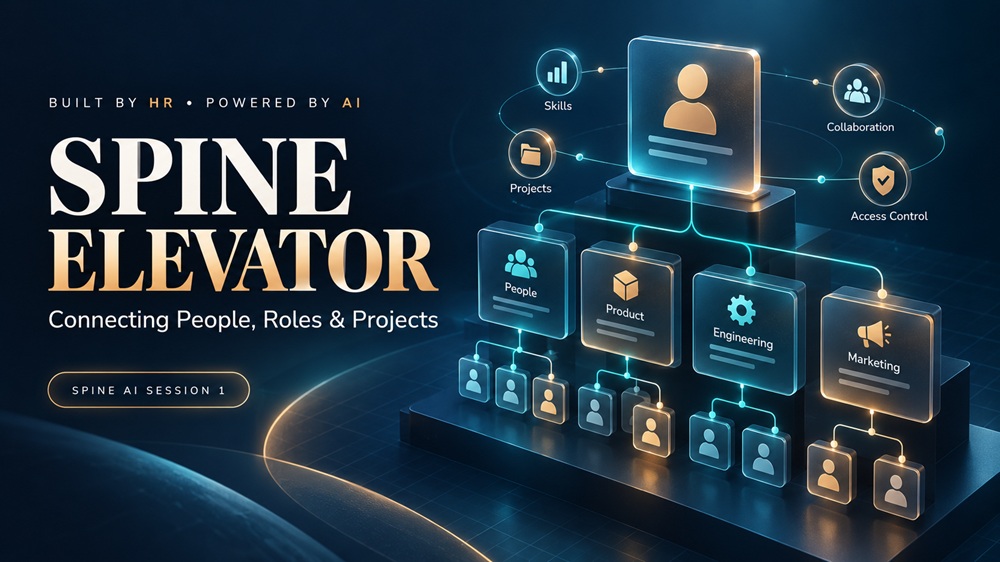
Developed by Spine’s non-technical HR team and presentedduring Spine AI Session 1, Spine Elevator combines an interactive organogramwith employee profiles, skills, project information and collaboration features.Its development also reflects the purpose behind Spine’s AI initiative: helpingdepartments identify manual work and use AI-assisted development to buildsolutions around their own requirements.
What Is Spine Elevator
Spine Elevator is an organogram and employee managementsolution designed to make organisational relationships easier to explore.
An organogram shows how an organisation is structured,including its departments, positions and reporting lines. Spine Elevatorextends that view by connecting the hierarchy with information about the peoplewithin it.
Users can explore the structure, open employee details andmove through different organisational levels. This gives the hierarchy apractical role in everyday work, beyond being a chart that someone occasionallyupdates.
An Interactive View of the Organisation
A large organisational chart can become difficult to followwhen every branch appears at once. Spine Elevator allows users to expand orconceal nodes and explore the hierarchy level by level, starting from the CMDlevel.
Single-click and double-click navigation support movementthrough the structure. Users can focus on a particular branch, inspect itsreporting relationships and then move to another level.
For HR, this creates a clearer way to explain how teams fittogether. For someone learning the organisation’s structure, it offers a routethrough the hierarchy without requiring them to interpret the entire chart atonce.
Employee Information Connected to Each Profile
A reporting line tells only part of an employee’s story.Spine Elevator connects the organisational view with employee profilescontaining details such as:
- Name and designation
- Department and reporting manager
- Email address and phone number
- Joining date
Keeping these details connected to the hierarchy addscontext. A user can understand where someone sits in the organisation and findtheir contact information within the same system.
Consider a new employee trying to identify the right personin another department. A connected profile can help them understand thatperson’s role and reporting relationship before reaching out.
Skills and Projects Alongside Reporting Relationships
An employee’s designation does not capture everything theycan contribute. Spine Elevator includes skills tracking, allowing skills to berecorded alongside employee information.
This provides another useful perspective on the workforce.When considering people for an assignment, recorded skills can help inform thediscussion alongside their department and current responsibilities.
The solution also includes project assignments, completiontracking and links between projects and subsidiaries. These features connectthe people view with the work being carried out.
A reporting hierarchy explains organisationalresponsibility. Project information adds visibility into assignments andprogress. Bringing both into the same environment can help users understand howformal roles relate to ongoing work.
Collaboration Within the System
Spine Elevator includes team chat and discussion features tosupport communication around work.
When people need to clarify an assignment or discuss aproject, having collaboration features within the system can keep theconversation close to the relevant employee and project information.
The value here comes from context. A discussion is easier tofollow when participants can refer to the responsibilities and assignmentsalready recorded in the system.
Automatic Saving and Update Records
Employee records need attention as people join, change rolesand take on new responsibilities. Spine Elevator includes automatic saving,along with appraisal and profile-update timestamps.
Auto-save supports the process of maintaining records, whiletimestamps provide context about when information was last updated.
Accurate records still depend on timely input from thepeople responsible for maintaining them. These features support that work bymaking changes easier to retain and update history easier to identify.
Access Linked to the Organisational Hierarchy
Employee information also requires appropriate accesscontrols. Spine Elevator includes hierarchy-linked access, with login and VPNaccess connected to the organisational structure.
This makes access management part of the solution’s design.The hierarchy serves as a basis for organising access alongside its role inshowing reporting relationships.
What the HR Team Demonstrated in AI Session 1
The story behind Spine Elevator matters as much as itsfeature list.
Spine’s management encouraged departments to examine theirworkflows, identify manual activities and use the AI solutions made availableto them to develop practical applications. Coding experience was not aprerequisite for participating.
The HR team brought its understanding of employee records,reporting structures and coordination needs to that process. ThroughAI-assisted development and vibe coding, the team translated those requirementsinto a solution it could present during Spine AI Session 1.
That demonstration gave the wider organisation a concreteexample of departmental participation in software development. The peoplefamiliar with the work could help shape how that work should be managed.
A Practical Step in Department Led Innovation
Spine Elevator brings organisational structure, employeeinformation, skills, projects and collaboration into a connected environment.Its features are built around questions that arise in everyday coordination:who someone is, where they report, what they can contribute and what they areworking on.
Its development shows how AI adoption can begin with adepartment examining its own needs. The HR team identified a usefulapplication, shaped its functionality and presented the result for others tolearn from.
For Spine, that is a practical expression of its wider AIinitiative: giving teams the opportunity to turn their understanding of dailywork into solutions they can build and improve.
